
Vibe Coding for Web Development: How AI Builders Are Changing Business Websites (2026)
What vibe coding is, where it beats traditional web development, where it does not, and how marketing teams use AI app builders like Lovable to ship conversion-focused sites in days.
Key Takeaways
- →Vibe coding means describing what you want in plain language and letting an AI builder write, run and iterate the real code.
- →For landing pages, MVPs, internal tools and lead magnets, AI builders cut delivery time from weeks to days.
- →Complex integrations, strict compliance and heavy custom logic still need experienced developers reviewing the output.
- →The biggest CRO win is test velocity: more variants shipped per month means more learning per month.
- →Treat AI-generated sites like any other site: check speed, accessibility, SEO metadata and analytics before launch.
 Lovable
- 01
Define the goal
Choose the audience, action and success metric.
- 02
Build and review
Create the page, connect the data and test the experience.
- 03
Publish and measure
Launch the asset and track conversions.
Disclosure: this article contains a referral link to Lovable. If you sign up through it, we both receive bonus credits at no cost to you. We only recommend tools we use ourselves — this very website is built with it.
What is vibe coding?
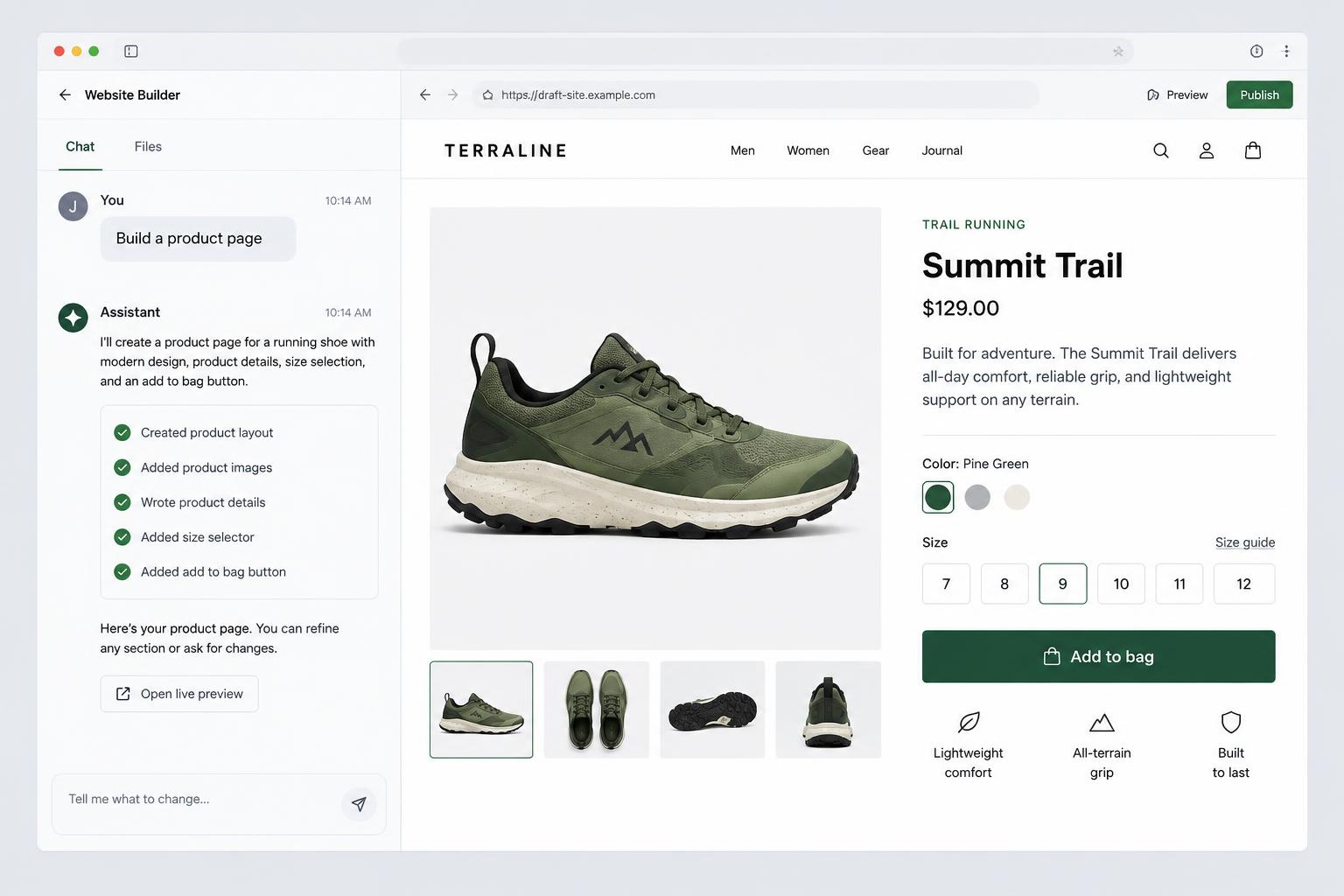
Vibe coding is a way of building software where you describe the outcome in natural language — "a pricing page with three tiers, an annual toggle and a FAQ" — and an AI agent writes the code, runs it in a live preview and refines it based on your feedback. You steer by intent rather than by syntax.
The term took off in 2025, and by 2026 AI app builders have matured from toy demos into tools that produce real React and TypeScript projects with databases, authentication and one-click publishing.
Traditional web development vs vibe coding
| Factor | Traditional agency build | Vibe coding with an AI builder |
|---|---|---|
| Time to first version | 3–8 weeks | Hours to 2 days |
| Cost of a landing page | €2,000–€10,000 | Subscription + a few hours of your time |
| Change requests | Ticket, quote, wait | Describe the change, see it live |
| Code ownership | Usually yes | Yes — exportable code and GitHub sync |
| Best for | Complex, regulated, large-scale systems | Landing pages, MVPs, tools, lead magnets |
Where AI builders win for marketing teams
- Landing pages per campaign: spin up a dedicated page per ad group instead of sending everyone to the homepage.
- Lead magnets: ROI calculators, quizzes and audit tools that capture emails and qualify leads.
- A/B test variants: build a challenger page in an afternoon instead of waiting a sprint.
- Internal dashboards: simple reporting tools on top of your own data.
- MVPs: validate a product idea with real users before committing a full dev budget.
Where you still need experienced developers
AI builders are not a replacement for engineering judgement. Payment flows, complex permission models, data migrations and regulated industries (health, finance) still need someone who can read and review the generated code. The practical model we see working: marketers build and iterate, developers review security and architecture.
Why this matters for conversion rate optimization
CRO is a volume game. Most tests lose, and the teams that grow fastest are the ones that run the most well-designed experiments. If each new variant costs a developer week, you run eight tests a year. If it costs an afternoon, you can run eight a month. See our conversion rate optimization services for how we structure test programmes.
A launch checklist for AI-built websites
- Page speed: check Core Web Vitals (LCP under 2.5s) — see our guide on page speed and ROI.
- SEO: unique title, meta description, canonical and one H1 per page.
- Rendering: make sure search engines receive full HTML, not an empty app shell (prerendering or SSR).
- Analytics: GA4 events for every form and primary button.
- Accessibility: colour contrast, alt text and keyboard navigation.
- Legal: privacy policy, cookie consent and GDPR-compliant forms.
Getting started
If you want to try it, start building with Lovable — sign up through our link to get bonus credits. Start with one small, measurable page (a campaign landing page is ideal), launch it, and compare its conversion rate to your current page.
Bottom line: vibe coding does not replace strategy, copy or design thinking — it removes the bottleneck between an idea and a live, testable page.
Recommended Tools
Lovable
AI app builder that turns plain-language prompts into full-stack React sites with database, auth and hosting. Sign up through our link to get bonus credits.
Explore LovableRelated Articles
Headless Commerce Platforms Compared (2026)
What headless commerce actually is, when it pays off, and how the leading platforms — Shopify Hydrogen, BigCommerce, commercetools, Saleor, Medusa, Vendure — compare in practice.
Read ArticleWhy Page Speed is the Silent Killer of ROI
A technical deep-dive into Core Web Vitals, performance budgets, and the direct revenue impact of every millisecond of load time.
Read ArticleThe Best E-commerce Platforms for Global Scale
A data-driven comparison of Shopify, BigCommerce, WooCommerce, and Magento for businesses scaling internationally.
Read ArticleCloud Hosting for High-Performance Sites
Compare managed hosting solutions that deliver the speed, security, and reliability your revenue-generating website demands.
Read ArticleWant a high-converting site without the long build?
We plan, build and optimize conversion-focused websites — combining AI speed with CRO expertise.
Explore web development